
Donors
Leonard and Florence Adams, Jamey Eddy, Walter Imfeld, Edwina Robertson,
Mark Robertson, Ross Robertson, Stapleton-Spence Packing Company, John
Sturdivant, Richard and Sandra Tjaden
Tony and Eddie Robertson ca. 1950s
Tony and Jamey Eddy
“Lit-up” Uncle Fester from the Addams Family
Tony with sh in Baja
In Memory of Tony Robertson
August 25th 1935 - May 25th 2008
— by Bill Murphy
I was nishing college in 1970 when I was intro-
duced to Tony Robertson by mutual friends Jorg
and Allison Meyer. I was living in Costa Mesa
then, and he had just moved there from Reno.
At the time he had a full head of hair, a beautiful
wife named Eddie, and a young son, Mark. Over
the years, his son grew into a ne man, his hair
disappeared, and his wife retained her charm
and beauty. While the covering on Tony’s head
changed with time, the passion and energy that
burned within him did not. I learned more about
Harris’ hawks in that rst meeting than I have
learned in any single day since then. Because he
was more experienced in falconry and seemed to
know what he was talking about, I tried to soak
in every word. In the 38 years that passed since
that rst meeting, I never stopped listening to and
learning from Tony. He was a gem of a human
being. Those who attended the early CHC meets
in Los Banos will remember the Robertson family
ying their Harms’ hawks in a cast. Rabbit popu-
lations were never the same in elds they passed
through.
Tony and Mark also had great success with prai-
rie falcons. Implementation of Tony’s formula for
imprinting an eyass falcon meant the difference
between a screaming maniac and a success-
ful game hawk. I still apply what I have learned
from him to this day. Their technique for training
passage falcons was equally as innovative and
effective. Mark’s passage prairie Muffet remains
one of the nest ying hunting falcons I have
ever seen. Tony helped me get my Cisco, my rst
Harris’ hawk in 1974. With his guidance, I found
more success game hawking than I could have
imagined. This bird took thousands of head of
game, fathered over 80 babies, and lived to be
28. Until the day Cisco died, he was still breed-
ing, copulating ve or six times a day. I remem-
ber phoning Tony after Cisco died and we joked
about wanting to see our lives end in a similar
fashion. Tony also helped me get my rst large
falcon in 1976, an imprint female prairie named
Chelsea. Again with his help and advice, I was
able to y my rst duck hawk. In those days, fal-
cons were rare and ducks were common, so I
was relatively successful because of Tony and in
spite of myself.
If I tried to record all the people Tony befriended
and helped with falconry, I would omit important
names and create a fragmented list at best. I
can say this. This list would include everyone
from outlaws to pillars of the community, and he
welcomed this wide range of characters into his
home. Although he could be a bit cantankerous
at times, he had a heart of gold, the gift of gab
and a willingness to help those who asked him.
He also had the energy and drive to hunt with his
birds all over the Western U.S. No one with him
slept in when sunrise hawking was on his agen-
da. When he passed away in Reno, he was there
to get a new bird. I spoke with him a few days
before his trip and he burned with the enthusi-
asm of someone getting his rst falcon. Tony and
Eddie were instrumental in the formation of the
California Hawking Club and worked tirelessly in
getting it started. Last year, the CHC Board voted
unanimously to award Tony a lifetime member
award, something he richly deserved. Because
he was unable to attend the Topaz Lake meet, it
was decided to postpone the award to this year’s
meet in Bakerseld. It saddens me deeply that
he will not be there to receive this honor. He was
my mentor and he was my friend. I miss him
greatly.
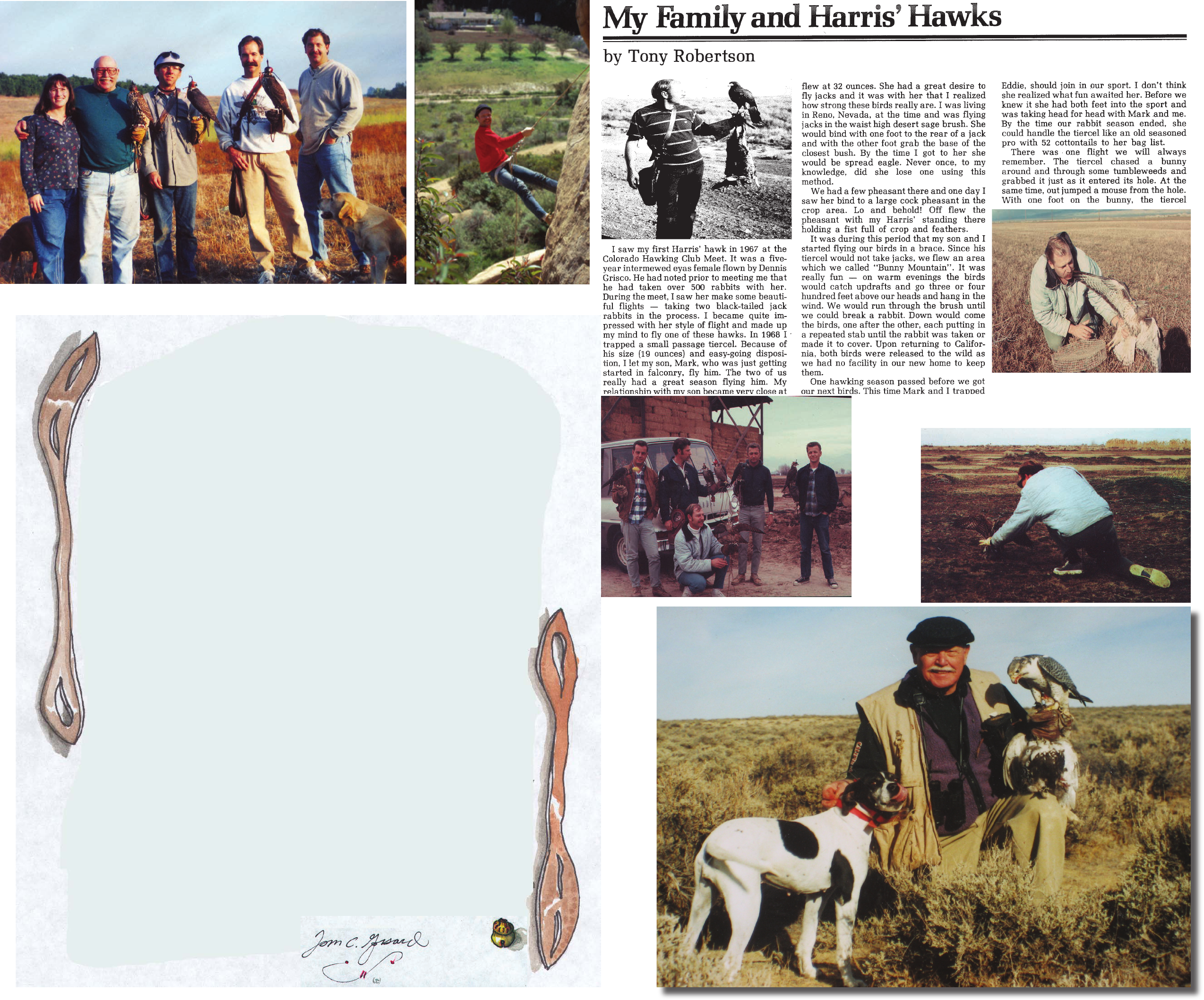
Paula Eddy, Tony Robertson, Jamey Eddy, Gary Boberg, Mark Robertson
CHC Journal 1973
1968. Rock Climbing.
Old Peregrine nest site.
Photo by Tom Gossard
Dec. 1968. Lancaster, CA. Ray Linder, Tom Gos-
sard, (kneeling) Tony Robertson, Mike Smith,
George Koon. Photo by Mark Robertson
As I remember my Friend, Tony Robertson
— by Tom C. Gossard
Tony and I met in the early 1960s. He was an engineer at the Rocketdyne Corp. located in the San Fernando
Valley. During those far away days the local falconers would work their hawks and falcons at the Sepulveda
Dam. It was a large tract of land in the middle of the Valley and had a variety of game. Sooner or later everyone
ended up there. I was ying an eyass tiercel Prairie Falcon there one evening when Tony and his good friend,
Ray Linder, came over and introduced themselves. They were just taking up falconry and wanted to learn
more about the sport. Ray was a grassroots kind a guy, but Tony seemed a little stuffy. The more he came
around to watch the hawks being own the more I got to know him. I found Tony to be an entertaining person,
well-spoken, educated, and with a fun sense of humor.
In 1967 Tony, Ray Linder and I attended the Colorado Hawking Club 1
st
annual meet in Sterling. Tony was
ying his eyass Prairie Falcon, Ray an eyass female Coopers Hawk, and I took my intermewed eyass female
Gos. Our good California friend, Dennis Grisco, was making a Disney movie in Utah and at the end of the
week he drove down to y his Harris’ Hawk with us. We made a bunch of new friends and had a great time.
Mike Arnold, Bob Martin and I had been hawking the Mojave Desert irrigation ponds with our passage Peregrines
with great success. After a few years Tony, Ray Linder and Mike Smith joined us with their fresh passage fal-
cons. Often times there would be a caravan of 2 or 3 vehicles full of falconers and falcons going from pond
to pond. I began to carry a “bota” full of wine so we could toast the successful hawker with a duck kill. With
a cheerful “falconer’s heil” it passed from one falconer to the next. We had all been up way before dawn, so
it sure cut the early morning mouth taste. We would work out a rotation so everyone had a ight at duck and
with a little luck, perhaps two ights at one pond. But our strategy did not always go as planned. A well-situ-
ated pond was found with a goodly number of small ducks on it. It being Tony’s turn, he walked away into an
open area to release his falcon. At this point a small cottontail ushed at his feet and it was just too much for
the falcon to ignore and after a short twisting ight she bound to it. I am not sure Tony was too happy, but we
all had a great laugh and a toast. Of all our game hawking ights which captured a large variety of game, he
was the only one of us to take a rabbit with a Peregrine. We had some wonderful game hawking — the things
that make myths, legends and history which can never be repeated. Tony was there to help create the legend
of the California Duck Hawkers.
Sometimes I would y the cottontails and coots around the ponds. Tony started bringing his teenage son, Mark
along. Soon Mark was ying his own Harris’ Hawk and we watched as a proud father saw his boy take a cot-
tontail, his rst head of game.
Tony moved his family to the Orange County area of California and shifted his career to sales in the food in-
dustry. Then, it was at the California Hawking Club Meet that we would get together, be brought up to date
and reminisce. We would talk on the phone occasionally and when his job took him back to the San Fernando
Valley, we would get together for lunch. Here he would regale me with his skin-diving adventures in the seas
off of Baja. I think he enjoyed diving as much as falconry. I still remember my friend Tony Robertson, and the
great falconry we enjoyed. Rest in peace olde friend.
Jan. 1968. Palmdale, CA., taking
38 ozs. Red-tailed Hawk off of Bal
Chatri. Photo by Tom Gossard
Tony taking his Peregrine off of a cottontail